data centre resillience
nature investment
find the environmental answer before it becomes the environmental Problem
for major infrastructure, nature should not be something you discover halfway through planning.
A new railway, data centre, energy project or other nationally significant infrastructure project inevitably changes the landscape.
The conventional response is to commission separate studies of biodiversity, water, flooding, carbon and mitigation — often from different teams, at different stages, answering different questions.
Nature Equity starts somewhere else.
We start with the Landscape.
Our Terrain and Habitat Foundation Models create an integrated environmental evidence base around the project, allowing developers to understand constraints, opportunities and potential interventions before committing to a mitigation strategy.
Biodiversity Net Gain (BNG) is part of that picture.
But so are water resilience, flood mitigation, carbon, nature recovery, land use and community value.
ONE LANDSCAPE. ONE EVIDENCE BASE. MULTIPLE FORMS OF VALUE
A new railway

01 start with the place
chosing the best sites.
the best site for a data centre is not just about power supply
Power and connectivity may get a site onto the shortlist.
-
They don’t necessarily make it developable.
-
What is the long-term water position?
-
What happens under future climate conditions?
-
Where does surface water go?
-
What environmental constraints surround the site?
-
What BNG obligation could development create?
-
Where could mitigation be delivered?
-
And how does the project create tangible value for the community hosting it?
DC-ERA asks these questions before the design becomes expensive to change. The new standard for the hyper scale data centre area that goes beyond current green labels and efficiency claims.
Our Terrain Foundation Model provides a common evidence base around the development, allowing environmental dependencies to be understood together rather than commissioned as disconnected studies.
Equip yourself with the best place based intelligence before you commit.
Key up to date with site constraints and identify mitigations as the project progresses.
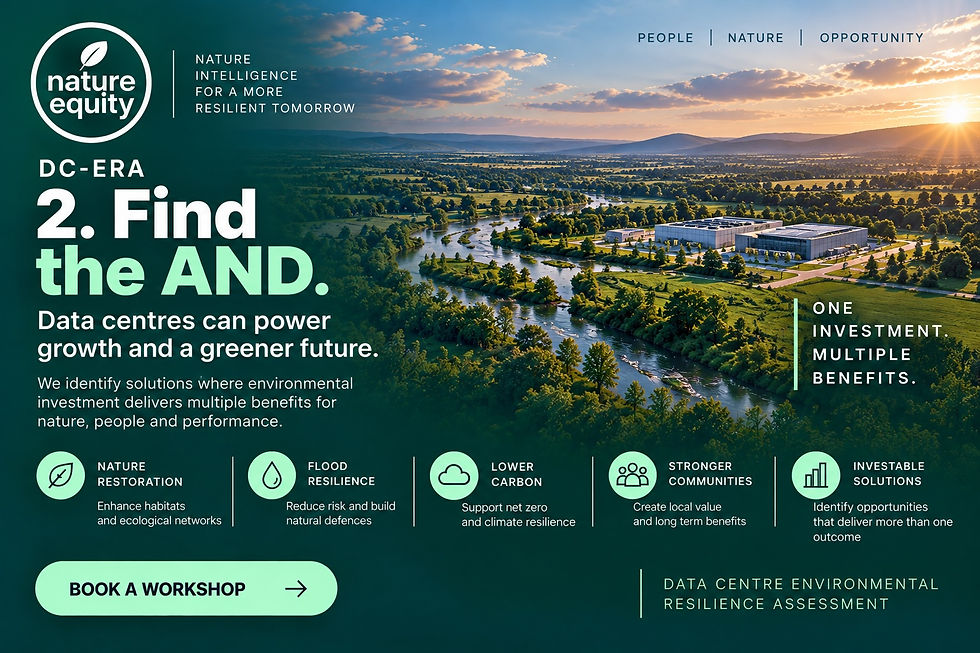
02 find the 'AND' dont get stuck on the 'OR'
a green AND Properous land
DATA CENTRES SHOULD NoT HAVE TO CHOOSE BETWEEN GROWTH AND THE ENVIRONMENT.
The debate around data centres is increasingly framed as a series of trade-offs.
-
AI OR water.
-
Growth OR nature.
-
Infrastructure OR communities.
-
Development OR climate resilience.
-
DC-ERA looks for the AND.
-
What if the environmental investment required by the development could solve several problems at once?
A catchment intervention could support water resilience AND biodiversity.
Natural flood management could reduce flood risk AND create habitat.
Habitat investment could deliver BNG AND contribute to local nature recovery.
Landscape investment could mitigate development AND create visible community benefit.
The same investment can create more than one outcome.
Don’t solve six environmental problems six different ways.

03 build the resilience stack
holisitc approach to resilience
achieving net zero emissions is not enough if the project is not resilient
Carbon matters. But a low-carbon data centre that is exposed to water scarcity, flooding, ecological constraints or community opposition still has a big problem.
Our Data Centre Environmental Resilience Assessment (DC-ERA) considers the project through an integrated environmental resilience stack:
WATER RESILIENCE
-
Understand supply, demand, catchment pressures and future resilience.
FLOOD & CLIMATE RESILIENCE
-
Understand current and future exposure and opportunities for nature-based mitigation.
CARBON
-
Address operational Scope 1 emissions and the wider implications of the development.
EMBODIED EMISSIONS
-
Understand important Scope 3 impacts associated with construction and infrastructure.
BIODIVERSITY NET GAIN
-
Understand the baseline, potential liability and opportunities for strategic habitat investment.
COMMUNITY VALUE
-
Identify opportunities for environmental investment to leave a tangible local legacy.
These aren’t six separate scores averaged into a comforting number.
Resilience is only as strong as the gate that fails.
DC-ERA identifies where the project is strong, where it is vulnerable and where intervention can change the answer.

04 turn mitigation into investment
mitigation as investment
you are going to spend the money. make sure it delivers the benefits
Environmental mitigation is usually treated as a cost of development.
DC-ERA asks a different question:
What else could that money achieve?
Instead of addressing BNG, water, flood and landscape mitigation independently, Nature Equity searches for opportunities where environmental investment can create compound value.
ONE INTERVENTION
could potentially contribute to:
Water resilience + flood reduction + biodiversity + carbon + community benefit.
Our wider Terrain, Habitat and Natural Flood Management intelligence allows us to search beyond the red-line boundary for those opportunities.
That turns environmental mitigation from a collection of obligations into an integrated investment strategy.
Spend once. Solve more.

05 make better projectss easier to say yes to
getting to yes in planning consent
the real output of dc-era is not a score. it is a better project
A successful data centre needs more than technical feasibility.
It needs a credible environmental story and implementation.
One that developers can explain to investors, planners, water companies, regulators, local authorities and communities.
DC-ERA provides an evidence-led framework for showing:
-
We understand the environmental capacity of this place.
-
We understand the project’s impacts.
-
We have identified the material resilience risks.
-
We have looked beyond minimum compliance.
-
And we have a credible plan to invest in the landscape that supports the development.
The objective is not simply to make a data centre less bad.
It is to make the place more resilient because the data centre was built there.
how we work together
12 - engagement
01
ORDER investment case study
FREE. ORDER ONE OF OUR PREPARED CASE STUDIES
Methodology, workflow, technical outputs and investment insights from a real project.
02
order rapid Data centre resilience baseline
FIXED PRICE. 4 WEEKS. INVESTMENT REPORT FOR CATCHMENT
A discovery workshop that leads on to a tangible, professional deliverable applied to your own assets and catchments.
03
full stack resilience assesment
PROJECT DELIVERY
Region-wide asset exposure, opportunity mapping and prioritised investment programme.
04
design mitigation package
LONG-TERM STRATEGIC PARTNERSHIP
Governed terrain, hydrology and asset and nature intelligence maintained across your estate covering natural flood management, natural capital accounts, biodiversity, water quality, and carbon accounting.
request more information
enquiry
I you are developer and want to understand more about our services for hyper scale and AI era data centres then please complete this contact form
don't run into delays in consenting process
The average planning delay from opposition to hyper scale data centres in the UK is currently 490 days with some projects taking 5 years in planning. Do not underestimate the need for robust resilience and demonstrable mitigation package. It needs to be an integrated robust and trusted package based on the best available evidence that gains the community full support.
Our DC-ERA assessment and mitigation roadmap is designed for the hyper scale era and goes beyond simple green labels and efficiency standards to address the issue of how we develop for resilience, nature positive outcomes and community support.
06 - our advantage
real landscapes need real evidence
ENVIRONMENTAL RISK DOES NOT EXIST IN A SPREADSHEET
It exists in a real landscape, where water, rivers, soils, habitats, flood pathways, infrastructure and communities interact.
Yet environmental assessment is often assembled from separate datasets, separate studies and separate specialists.
We start with the landscape — and build the evidence around it.
Nature Equity’s Terrain Foundation Model and Habitat Foundation Model combine UK wide multiple authoritative sources of environmental evidence into a governed, spatial understanding of the landscape surrounding the development.
Rather than relying on a single model, map or dataset, we bring together evidence across:
Terrain + Hydrology + Flood + Water + Habitats + Soils + Land Use + Carbon + Infrastructure + Climate
This allows DC-ERA to examine the relationships between environmental risks, not simply report them separately.
A MAP TELLS YOU WHERE TO LOOK. EVIDENCE TELLS YOU WHAT TO DO.
Two apparently similar data-centre sites can have profoundly different environmental consequences. The difference may sit outside the red-line boundary.
-
Upstream in the catchment.
-
Inside the water-resource system.
-
Along a flood pathway.
-
Within surrounding habitats.
-
Or in the cumulative demands being placed on the landscape.
-
That is why we don’t start and stop at the development boundary.
We understand the catchments, landscapes, communities and systems the development is joining.
ONE LANDSCAPE. ONE EVIDENCE BASE. MULTIPLE DECISIONS.
The same environmental foundation can inform decisions about:
-
Water resilience
-
Flood mitigation
-
BNG and habitat creation
-
Carbon
-
Land-use intervention
-
Nature-based solutions
-
Community and environmental investment
That creates something very different from a collection of environmental reports.
It creates a common evidence base from which the project team can decide where intervention will create the greatest combined value.
REAL LANDSCAPES. REAL EVIDENCE. REAL VALUE.
Because the quality of the mitigation can only ever be as good as the understanding of the place.
DC-ERA turns environmental data into landscape intelligence and landscape intelligence into better development decisions.